Overview
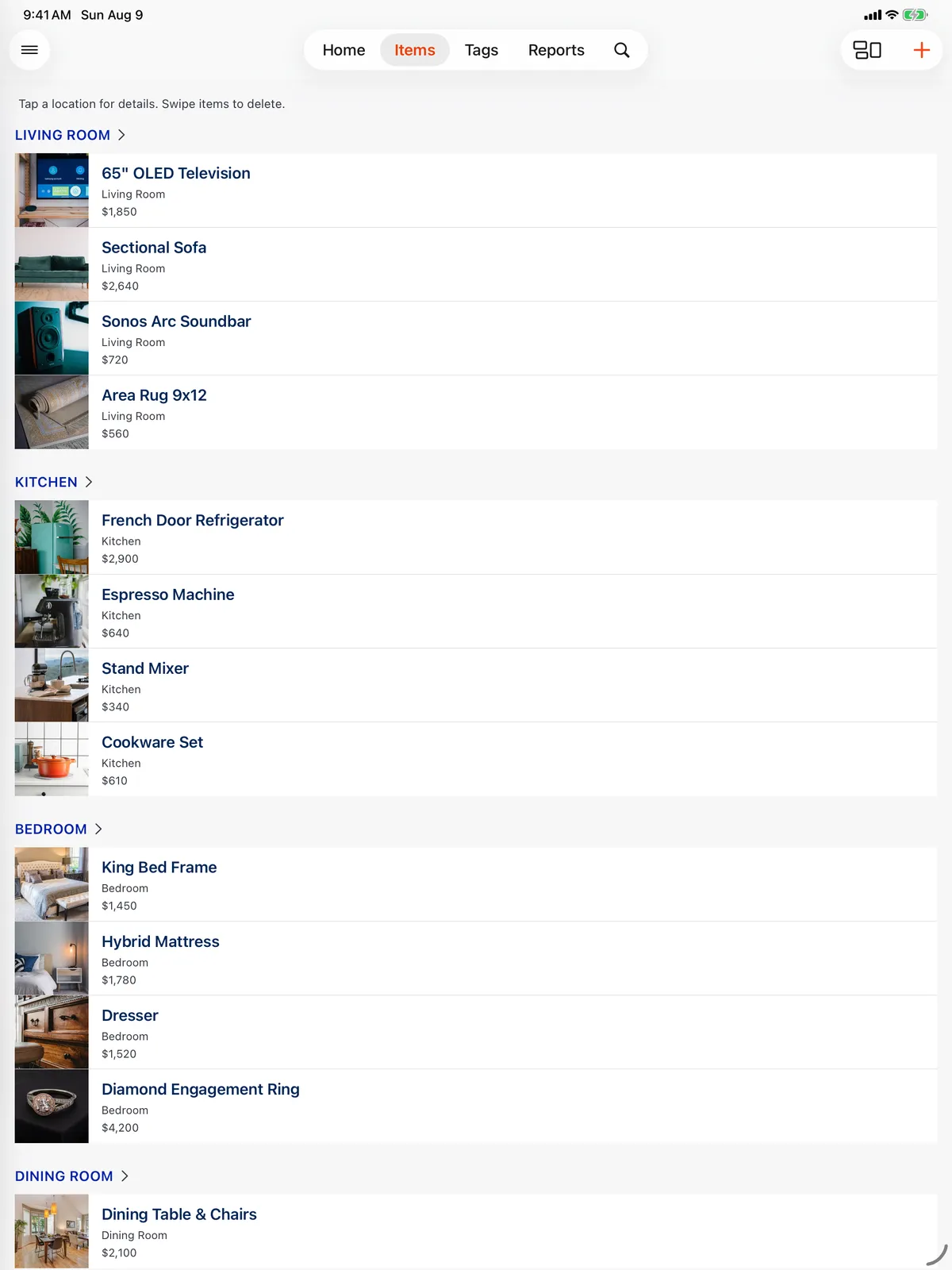
An offline home inventory app for storm season and insurance claims, built for iPhone and iPad and currently in App Store review. Catalog a property room by room with photos, receipts, and serial numbers, then hand your adjuster a document instead of reconstructing the contents of your house from memory. The real problem was never storage, it was that almost nobody finishes a home inventory: photographing a house one item at a time takes days. So the capture flows got the attention. Burst mode turns a sweep of photos into several draft items in one pass, a document scanner pulls in receipts and manuals, and a bulk import handles a camera roll you already have. The output is the other half. Inventories export as CSV, a multi-sheet Excel workbook, or a PDF with the photos embedded, and the app assembles a Proof of Loss from the items you select. That document follows the Florida sworn statement format, including the fraud notice the state requires, and it is a draft the user reviews rather than legal advice. No backend and no account: everything is on-device via MMKV, which is the right call for an app you need working after a storm with no cell service, and an explicit tradeoff, since a lost phone means a lost inventory until cloud backup ships. Built with React Native and Expo, alongside a static Next.js marketing site at itemizedhome.com.
How it’s built
The bottleneck was capture, not storage
Almost nobody finishes a home inventory, because photographing a house one item at a time takes days. Burst mode turns a sweep of photos into several draft items in one pass, a document scanner handles receipts and manuals, and a bulk import takes a camera roll you already have. The database was the easy half.
Local-first, and the tradeoff stated out loud
Inventory lives on the device via MMKV. No account, no backend, no sync, which is what makes it work after a storm with no cell service and means nobody here can see a customer’s belongings or policy numbers. It also means a lost phone is a lost inventory until cloud backup ships, so the app pushes exports as the interim answer rather than pretending the gap is not there.
A legal document generated from a database
The Proof of Loss follows the Florida sworn statement format and includes the fraud notice the state requires, assembled from the items the user selects and prefilled from a per-property insurance card. It is framed throughout as a draft the user reviews, not legal advice, and the state-specific wording is isolated so other states become a lookup rather than a rewrite.
Exports as a first-class surface
CSV for a spreadsheet, a multi-sheet Excel workbook split into summary, items, rooms, and tags, and a PDF with the photos embedded, all handed off through the system share sheet. An inventory nobody can send to an adjuster has not done its job.
A feature built, shipped, and then removed
Automated home valuation went in, worked, and came out again: it pulled attention away from the inventory core and meant a paid API bill on a free app. Cutting shipped work is more useful to write down than another feature that survived.